

Day 51 Of The 2025 MLB Season
My pal Andrew flags this for me: “If you see this play description, what would you think happened?”
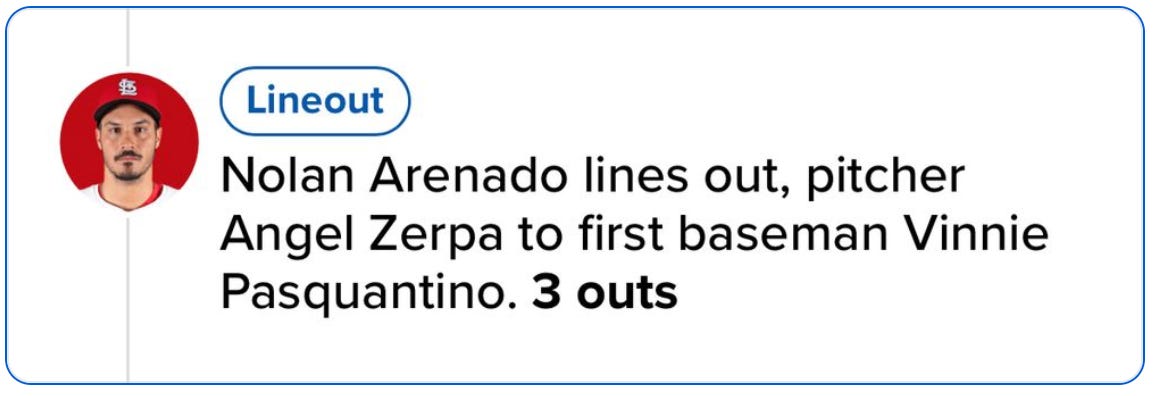
The answer seems pretty simple: Ball lined back to the pitcher, deflects off him, first baseman catches the redirect in the air. But since Andrew went out of his way to ask, it feels like it must be somewhat odder than that, so: Maybe the first baseman was playing in a shift, and caught the ricochet diving near second base? Maybe the liner was off the pitcher’s front toe and shot up in the air like a geyser, something comically unlikely like that? Or off the pitcher’s forehead, something extremely dramatic that gets watered down by the plain textual description?
But the mechanics of the play seem clear enough: Ball goes one direction, redirects in another, we’ve got a guy there, and the play is over.
Now, I’m going to tell you what the clue didn’t reveal, and you can resume pondering:
This play lasts 50 seconds.
Hmmmmmm—
If you’ve finished thinking about it, here’s that clip:
Arenado missed first base and it wasn’t that close. Looks like his first base coach saw it and maybe was yelling at him to come back, but there’s Arenado chugging ahead—he must know he missed it, and yet,
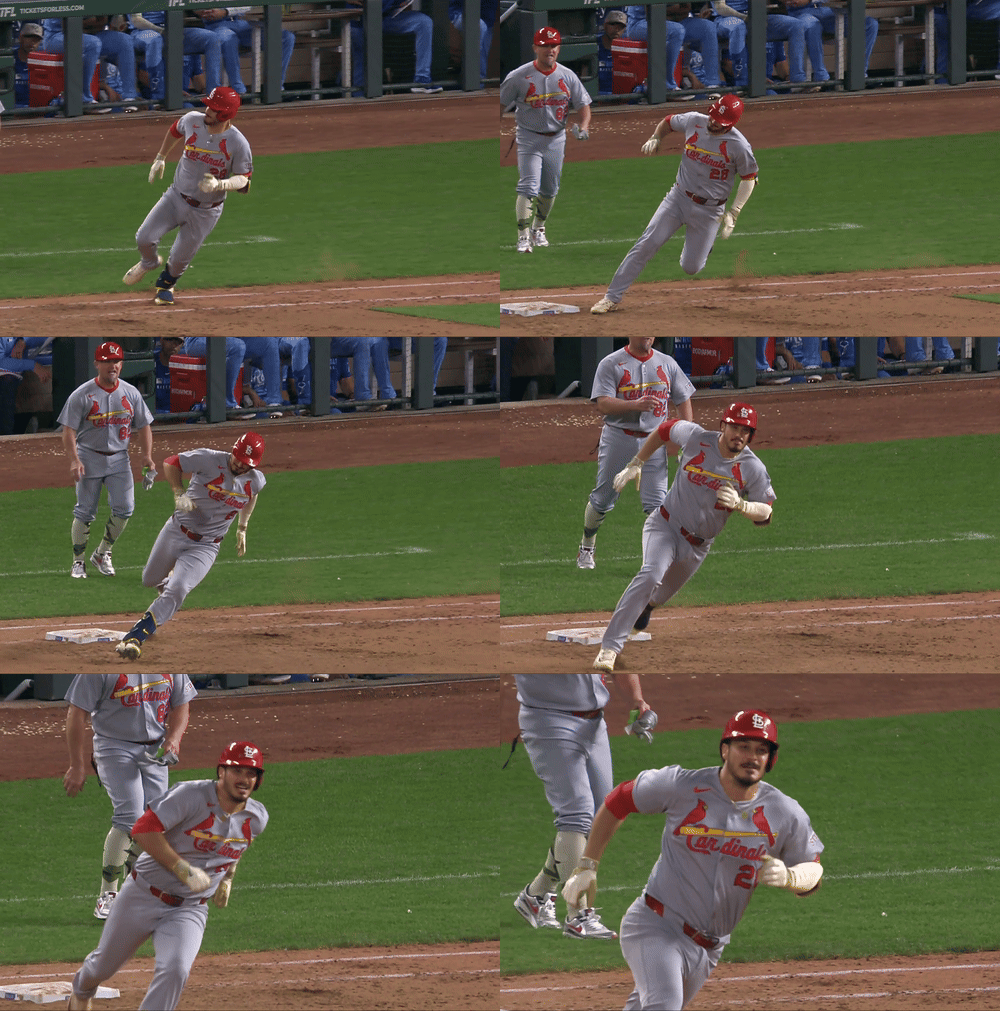
what is going on in that head?
Everybody in the Cardinals dugout also seemed to know. They were yelling “go, go, go” at him right before the pitcher made the appeal to first, because—this is a little technical— if a separate play occurs before the pitcher makes the appeal, then the defense’s right to appeal expires. Taking off for third base in hopes of drawing a throw there was Arenado’s hail mary. It didn’t work. He was out, pitcher Zerpa to first baseman Pasquantino.
Writers (in theory if not practice) and editors (especially) are obsessed with concision, with using as few words as possible to communicate an idea. (I’m a writer without an editor and thus left the previous sentence several words longer than I should have, and also added this unnecessary parenthetical.) So I’m very interested in the question of how one best communicates what happened in the above play within the tight confines of play-by-play logs. To me, the MLB description that Andrew brought to me is not super great. So let’s take a tour of the other play logs that are out there, from shortest to longest and/or from most informative to least:
7. CBS
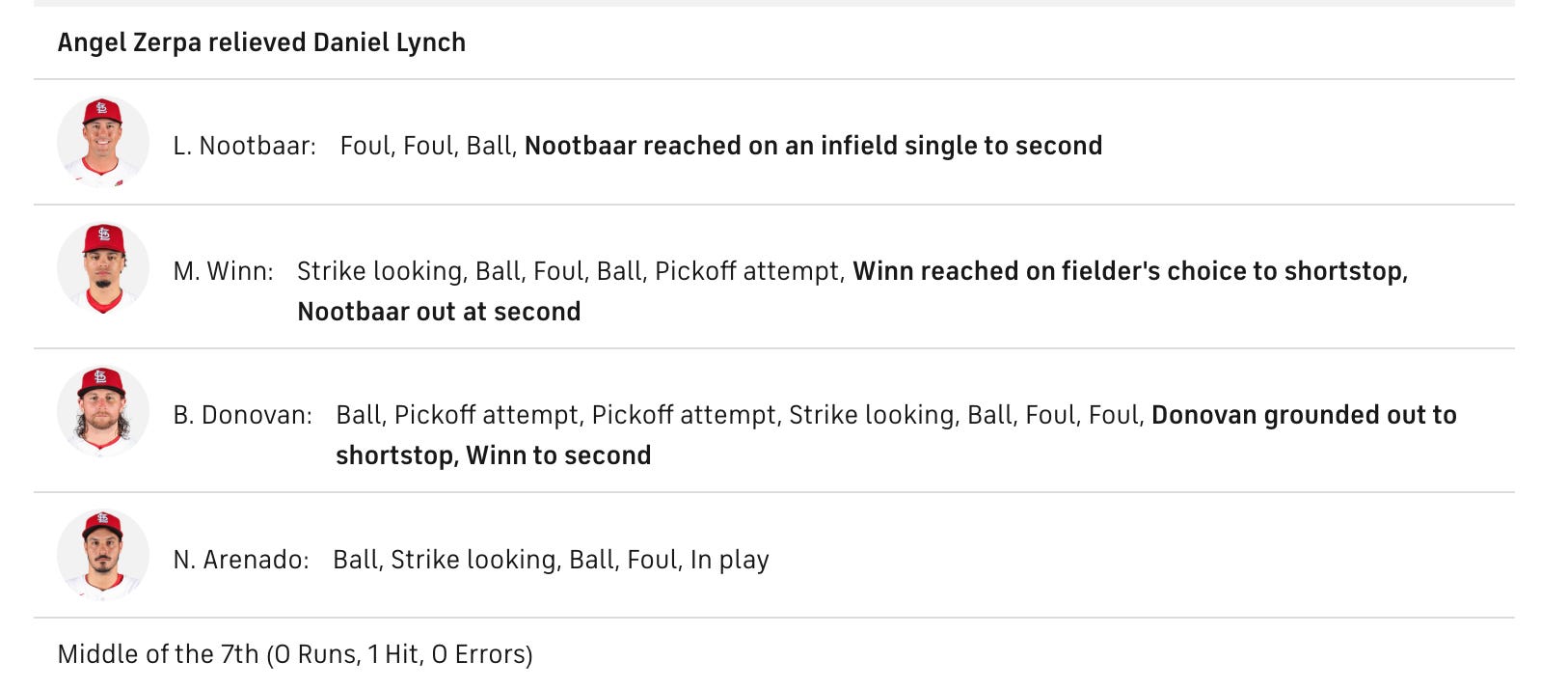
CBS just gave up mid-play. There is no description given or implied except that Arenado didn’t strike out and, somehow, the inning ended scorelessly. CBS narrowed down the possibilities to several thousand.
6. Yahoo!

Four words, very direct, eliminates maybe 80 percent of the possible plays that CBS left in, and tells you the trajectory of the ball. It’s misleading, though: “Lined out” with no other action implies a caught ball. This is like describing the movie Jaws as “A man goes fishing.”
5. ESPN
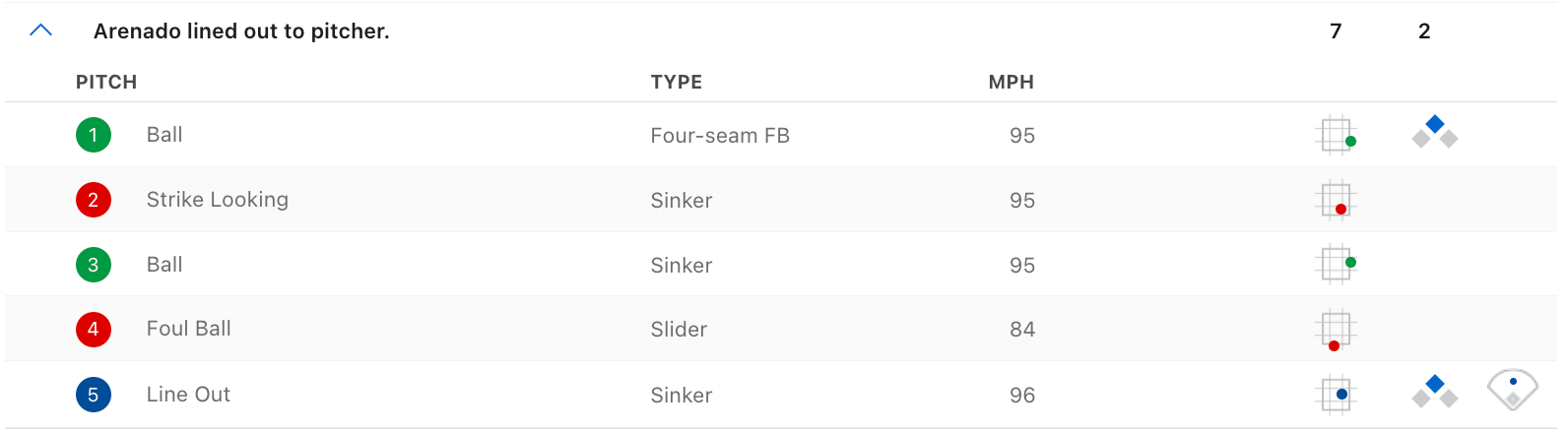
Has most of the same limitations as the Yahoo! description, but it does introduce one of the characters: “pitcher.” Doesn’t tell us what the pitcher did, and obviously implies that the ball was hit to the pitcher (it wasn’t) and that it was caught (it wasn’t). But you can see at the bottom right of that screen grab that a little diagram shows where the ball landed: out in center field. Five words + image gives the close observer the clues needed to know something disorderly happened that isn’t captured in the text.
4. FanGraphs

Six words, and while this description wildly misleads you on almost every level, it’s the first one we’ve seen that captures the key feature of this play: The batted ball hit the ground before any defender had touched it. You wouldn’t call a ball hit into the outfield at that trajectory a grounder exactly, but in one sense of the word it kind of was, since it was picked up off the ground by a fielder and (eventually) delivered to first base for (basically) a force out. The sequence had much more in common with a groundball that with a line drive, and I like that FanGraphs’ description goes there.
3. Baseball Reference (pt 1)

Five words, unless you count the hyphen between P and 1B, since it obviously stands for the word “to.” This is the only one so far—excepting the ESPN field diagram—that makes it clear this was no normal play. It tells you that, despite being a “lineout,” there was a throw from pitcher to first, meaning no catch. It tells you that the ball landed between left and center field, which upturns your assumptions from previous sentence, and it thus eliminates any simple guesses you’d have made for this play.
2. Baseball Reference (pt. 2)

That’s the Retrosheet code for this play, which B-Ref also publishes in its game logs. It’s the same information that you get in “Lineout: P-1B (LF-CF)”, but in a professional-grade six characters. Still leaves out what Arenado was doing all this time, etc.
1. Statcast play diagram

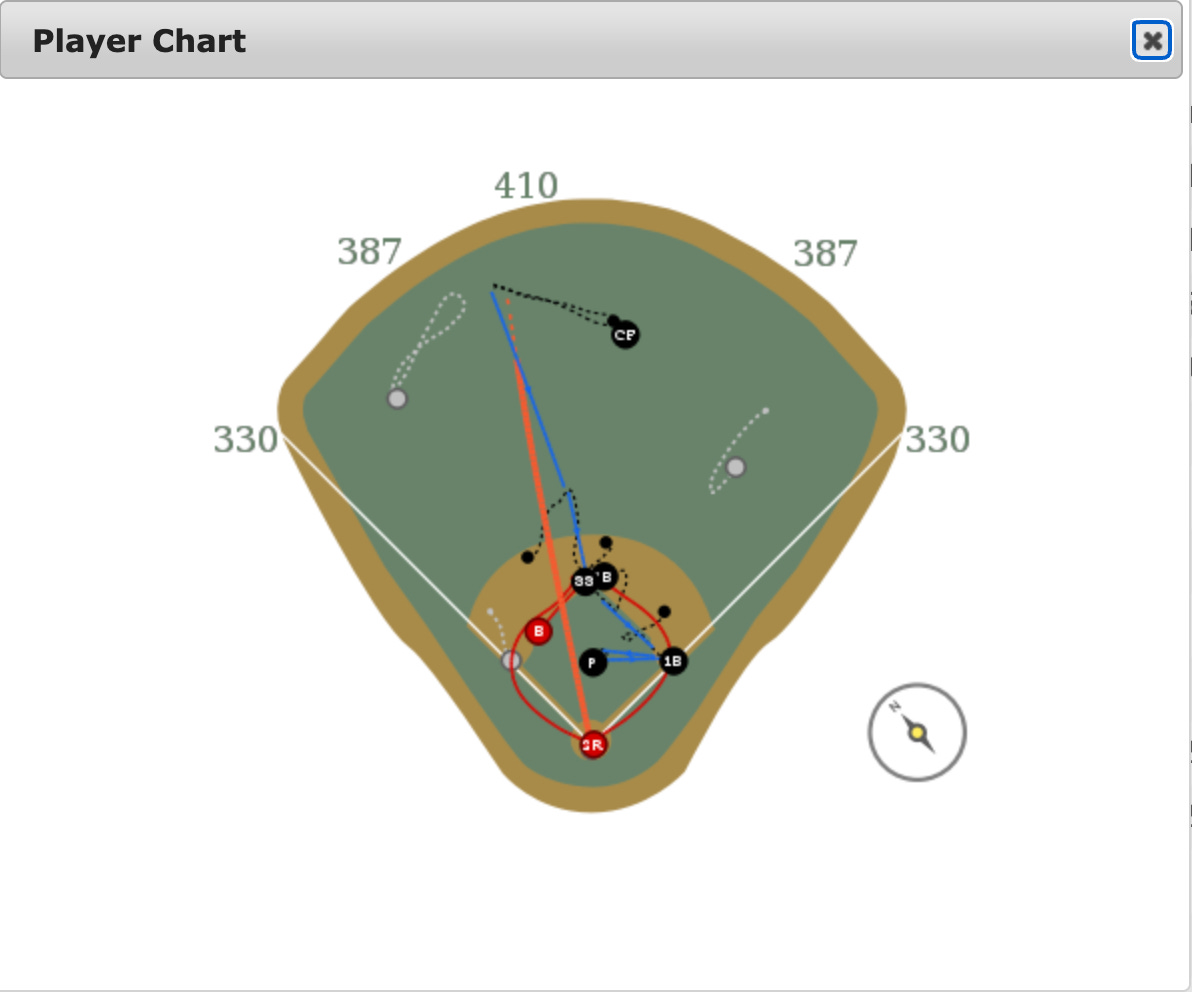
This is obviously not a fair fight, putting a whole complex picture up against a few words. Even with that, it’s still not easy to piece this play together unless you already know what happened.
**
What complicates this task is that most of what happened in the play didn’t technically happen. Arenado was (basically) forced out at first for the third out, ending the inning. Thus, the runner who started at second base never scored. Thus, Arenado never actually got to second base. Thus, Arenado never took off stealing for third. He took an extremely slow path to first base, by which point the throw had gotten there, and he was forced out for the final out of the inning, making everything that you thought you’d seen get retroactively wiped from existence.
Really, here’s all that happened: Line drive to left-center, Arenado out at first, 8-6-4-1-3. That’s 15ish words. It doesn’t tell you everything. You’d still need to make the leap to Arenado missing the bag and the appeal being made. But it’s close.
*
*
*
Day 52 Of The 2025 MLB Season
