
Forgetting Some Guys
Modern baseball puts up numbers.

Day 143 Of The 2025 MLB Season
During the Mets game, this exchange:
Steve Gelbs: You obviously go into the game with a plan against a pitcher. How often would that plan have to get thrown out the window because of the way that pitcher was pitching that day?
Keith Hernandez: It didn’t happen too often. The pitcher has his stuff and you have an idea. More so in my day because there were less teams. You only played in one league and it was four less teams and you played in division a lot. You knew the pitchers.
We already basically knew what Keith’s saying here: Today’s batters have to face more individual pitchers. But I was not prepared for the scale of the difference. Here’s my favorite fun fact from the 2025 season:
Keith Hernandez played 17 seasons in the majors and faced 593 different pitchers. Andrew McCutchen has played 17 seasons in the majors, and last year he faced his 1,500th different pitcher.
On September 20th, when he faced the impressive Athletics rookie Luis Morales, McCutchen’s unique visitors rose to 1,527. Carlos Santana, in 16 seasons, tallies even higher: 1,536 pitchers faced. (Lou Gehrig, a few generations before Keith Hernandez, faced 345 pitchers.)
Familiarity benefits hitters, who can best perform the pattern recognition that’s the foundation of hitting once they’ve been exposed to the pattern. About 25 years ago, Tom Ruane tried to quantify the effect. It’s difficult to isolate just the familiarity factor—as Ruane showed, in a series of updates—but his findings suggest an OPS swing of somewhere between 10 and 30 points, depending on whether a batter has seen a pitcher <5 times or >15 times.
Keith Hernandez’ median plate appearance as a big leaguer was against somebody he had already seen 15 times. Once he debuted in the majors, he was immersed in a fairly cohesive, connected storyline, with foes he’d seen over and over, with each day’s at-bats a continuation of the education he’d begun many years earlier. It’s a dramatically different sport for McCutchen, and everybody else in modern ball. McCutchen’s median plate appearance is against a pitcher he has faced just six times. He’s seeing new characters in practically every scene—17 seasons in, and he still had to face 101 pitchers for the first time last year—and at any given time he’s got to keep almost 1,000 active characters straight.
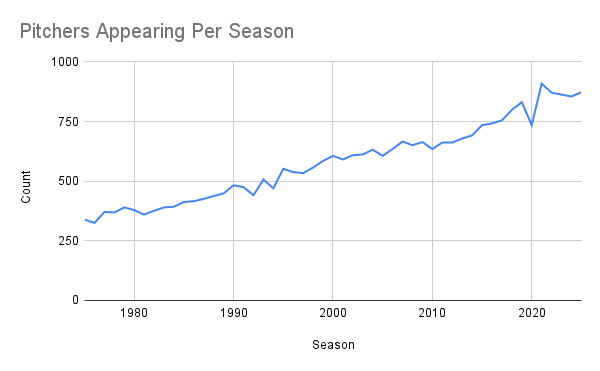
As Hernandez said, a lot of this is due to scheduling—interleague play, balanced schedules—but a lot is also just how many pitchers there are now, and how much roster churn. Almost three times as many pitchers now appear in the majors than did during the early part of Keith Hernandez’ career:
**
Back when I was on the education beat at the Orange County Register, I covered an exurban high school that had, controversially, grown quickly and become extremely crowded. Some people loved their enormous school. An enormous school has a great football team, for instance, and an enormous school gets to build a gorgeous expanded performing arts center. The problem was that, whether you have 2,000 students or 4,000, there’s still only one football team, so your chances of playing on that football team are a lot smaller. There’s still only one lead in the school musical. You get to go to this great school, but you’re likely to be squeezed out of many of the experiences of high school.
Last month, at photo day, the Red Sox reliever Zack Kelly held up a piece of paper with a hand-written plea:
