
No Checking Scores
On keeping things in play.

Day 47 Of The 2025 MLB Season
Francisco Lindor grounded out, a two-hopper. The second hop came off the infield dirt. Afterward, this:
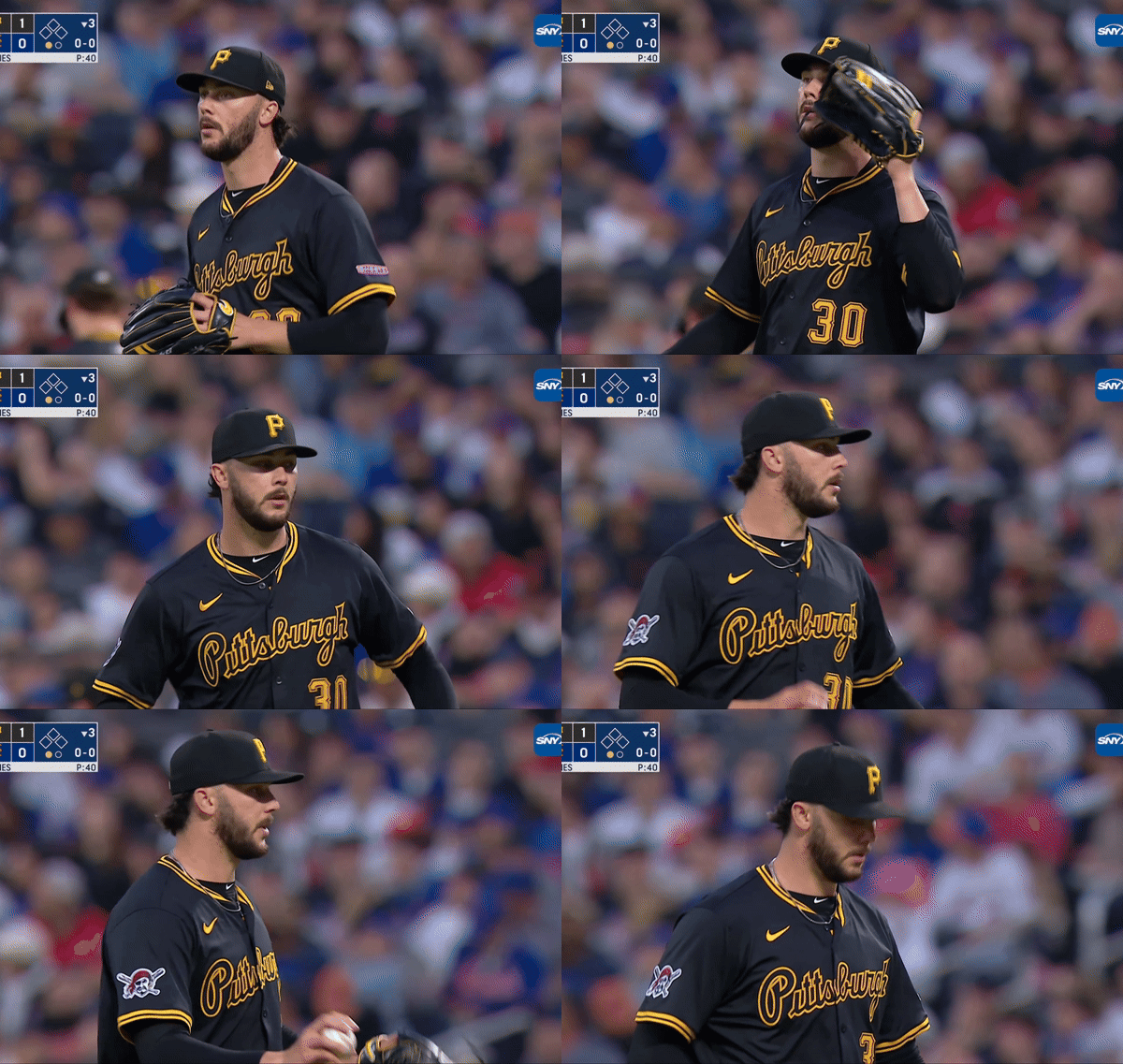
On the Mets’ broadcast:
Keith Hernandez: Tiny little thing, but Lindor just grounded out to second and they went to take the ball out and Skenes said ‘no.’ He kept the ball that was a play on the infield. That does not happen in today’s game. Never see it.
Gary Cohen: Does that mean he knows how to use a scuffed ball to his advantage?
Keith: I think he just likes the grip of a ball that has been on the infield—it gets a little scruffed up.
Gary: Which is a very interesting point: There’s been all this conversation in the last five or 10 years about the grip on the ball and the sticky stuff and should they go to the tacky ball that they use in Asia. Best way to get a grip is to use a ball that’s been in play.
Keith: Keep the ball in play!
*
A reader named Jody emailed me a little while ago—
Please know that I’m not sending this as a way to get you to start focusing on it. But I can’t unsee it now (so to speak) so I’m curious — Have you seen a ball hit the dirt this year that stayed in a game? I haven’t been able to spot one yet. Most balls in play = gone. Any ball that bounces = gone.
I told him about the Lindor/Skenes grounder. He told me that, shortly after emailing me, he had finally seen his first dirty balls stay in play—but they had come with a position player on the mound. Luis Vázquez was on the mound in a blowout, so nobody bothered to swap new balls in.
At this point, I was pretty sure I was going to join Jody in the obsessive dirty-ball watch. But Andrew Miller, whose sporadic Fourth Base newsletter is always delightful, bailed me out by writing about it first. He tracked every ball, dirty or otherwise, in an entire game he spent at the park. (With a great, unexpected ending!) I like Andrew’s post, so I’m not going to spend any more energy on this issue. There is, however, one unanswered question from his post, which might burrow into my brain and lay eggs:
On one occasion, umpire Clint Vondrak received a reject baseball from Giants catcher Patrick Bailey, looked it over, and put it back in his pouch for re-use. What happened here? Did Bailey mistakenly hand over a clean baseball? Did he and Vondrak have different standards for admissable baseball scuffage? What happened to this ball when it was re-issued?
This raises the possibility that, when you see a baseball retired, it might be an illusion—the umpire might simply be slipping it out of sight and then reintroducing it later.
*
*
*
Day 48 Of The 2025 MLB Season
Twenty years ago today, I turned 25. I figured it was getting late in the game for me, and if I didn’t want to waste the rest of my life I’d better make a plan. On a yellow legal pad, I set down—in 10 sentences—a vision for where I wanted to get to by July 2025, concluding: “I want to write profiles in the New Yorker by July 17, 2025.”
That done, I sketched out some stations: Where I would need to be within 15 years, within 10, within two, within one, within a month, within a week. In this way, I imagined what would be, more or less, the bulk of my life, the 20 years during which I would accomplish most of what I would accomplish.
Just about the same time, Rich Hill made his debut in the majors. In one inning he allowed two runs, a rally that began with a double by 22-year-old left fielder Miguel Cabrera. Hill, like me, was 25.
*
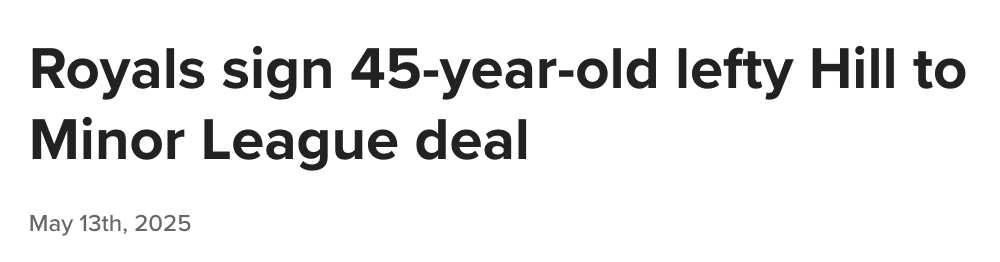
On the 48th Day Of The 2025 MLB Season, the most memorable event was a minor-league signing: The Royals had picked up Rich Hill, with the plan of stashing him in Triple-A in case their (very deep) rotation needed help.
I’ve got a lot riding on Hill. He’s the last human who is a) older than me and b) has a plausible chance of appearing in the majors again. Professional athletes set a sort of boundary for the human prime. If Rich Hill makes it back to the majors, that means I’m still in the prime of my life. If he doesn’t make it back, it means the prime of my life ended last September, when I became older than any big leaguer.
Lots of people actually have a lot riding on Hill. He’s not just older than any other big leaguer; he’s quite a bit older, with nearly three years of age over Justin Verlander. From the day Hill was born until the day Verlander was born—a span of 1,076 days—approximately 10.8 million Americans were born, and (based on SSA actuarial tables) around 10 million are still alive. There are 10 million Americans whose primes are hanging on Rich Hill’s Triple-A stats.
*
Regardless of which way it ends up going for Hill, he’s already become historically significant, as a Last Player Older Than [Me], where [Me] stands in for some cohort of human births. Since 1950, there have been only 33 of these1:
Rich Hill
Albert Pujols
Ichiro Suzuki
Bartolo Colon
LaTroy Hawkins
Jason Giambi
Mariano Rivera
Jamie Moyer
Julio Franco
Jesse Orosco
Tom Candiotti
Dennis Martinez
Dave Winfield
Charlie Hough
Nolan Ryan
Tommy John
Phil Niekro
Gaylord Perry
Willie McCovey
Joe Hoerner
Henry Aaron
Orlando Peña
Don McMahon
Hoyt Wilhelm
Warren Spahn
Diomedes Olivo
Bob Boyd
Mickey Vernon
Enos Slaughter
Ellis Kinder
Connie Marrero
Satchel Paige
Luke Appling
You might notice a few things about that list. One is that it’s filled with superstars. There are 13 Hall of Famers—and Pujols will be the 14th, and if Justin Verlander outlasts Hill he will be the 34th player on the list and the 15th in the Hall—which goes contrary to the myth that greatness is mostly intertwined with youth.
Another is that, in a 75-year span, there are far fewer than 75 names. Being the oldest surviving player doesn’t actually mean you’re close to finished. Of the 33 people who became the oldest surviving major leaguer, 19 played another year after that; 12 played at least two more years after that; six played for at least three additional seasons; and Hoyt Wilhelm played a total of seven seasons as the majors’ oldest player. He was also seven years older than the next oldest player in his final season, which means the day Hoyt Wilhelm retired something like 30 million Americans became old.
*
One more thing you might notice is how easily you can recall many of these players—especially the more modern ones—being on the brink. The most obvious example, in a list filled with obvious examples, is Tommy John, the first pitcher in the history of the universe to fully recover from a torn ulnar collateral ligament2. Did you know that, after Tommy John came back from the very first Tommy John surgery, the next seven pitchers to have Tommy John surgery failed to make it back to the majors? The first pitcher to replicate Tommy John’s Tommy John success was Tom Candiotti, who is also on that list up there.
Charlie Hough was a mediocre career reliever as late as age 32, when he suddenly turned into a successful starter. Dennis Martinez was below replacement level over a four-year stretch around age 30, until the Orioles staged an intervention for his alcoholism and he entered rehab. Julio Franco played in Japan at 39, in Mexico at 40, in Korea at 41—and somehow made it back to the National League for seven more years as a league-average hitter. Jamie Moyer was released by three teams in three years in his late-20s, and spent his entire age-29 season in the minors. Mariano Rivera had zero saves until he was almost 27. LaTroy Hawkins had a 6.66 ERA at age 26. Bartolo Colon, at 37, had a shoulder surgery so novel that the league actually investigated it3. Jason Giambi, Albert Pujols and Ichiro Suzuki all dropped below replacement level but each managed to rebrand and hang on for a half-decade longer.
It’s only in comparison to some of those guys that Rich Hill isn’t the wildest career arc in the room. At age 25, Hill was a promising starting pitching prospect; at 27, he was a successful starter; at age 29 he had a 7.80 ERA; over the next five years he threw a total of 75 innings in the majors; at 35 he was an indy-ball teammate with a guy who’d been a Sonoma Stomper two months earlier. At that point Hill had made $3 million as a major league baseball player, about 4 percent of what he would make in his next, unimaginable decade.
The Royals entered this year with the second- or third-best rotation in baseball. It’s trite to reiterate at this point that life surprises us, but their ace Cole Ragans is shelved with shoulder problems and a few days ago Michael Lorenzen went down with an oblique strain and Seth Lugo is going to get traded by the end of this month. Hill’s performance at Triple-A has been uneven, but he just had his best start there—10 strikeouts in five innings of one-run ball. The conditions required for him to appear in the majors this year are improving.
**
For about six weeks after I turned 25 I updated my 20-year path, logging my progress and updating the goals for each new week and month. I was an education reporter at the time, and most of my goals centered on diligence: Keeping up with my actual work, rather than checking baseball scores all day. Over and over, I commanded myself: No more checking scores during work! Read all the emails from the education-reporters’ Listserv instead of following baseball all day!
Then the trail stops. The legal pad got stuffed away. The next time I wrote anything in it, it was just some scribbled notes about José Arredondo and the Angels’ bullpen—I’d become, completely unexpectedly, a baseball writer.
Previously: Days 45 & 46 Of The 2025 MLB Season
Next: Days 49 & 50 Of The 2025 MLB Season
For simplicity, I treated a player as active if he appeared in the majors at all in a season, and I ignored a couple of stunt appearances by extremely older players.
Fun detail I didn’t know before this:
Tommy John before Tommy John surgery: 31.1 WAR
Tommy John after Tommy John surgery: 31.0 WAR
Baseball Prospectus hands out the Vogelsong Awards to the best players who weren’t so much as mentioned in the previous year’s BP Annual. This dates back to a piece I wrote in 2012, which led off with Ryan Vogelsong. But Bartolo Colon, left entirely out of the 2011 Annual, was also part of that piece. “What we’ve learned: Literally every pitcher alive is a candidate to pitch successfully in the majors.”
Most of my friends and co-workers are non sports fans, there are certain analogies or conversations that are impossible to have with non sports people. One of them is the feeling, the indescribable and persistent awareness of time, we (sports fans) have every time we look at players' career stats page.
The New Yorker would be lucky to have you!