

Day 28 Of The 2025 MLB Season
Freytag’s Triangle describes the basic structure of nearly all narratives: Rising action —> climax —> falling action —> resolution. George Saunders, in his book about Russian short stories, notes that it’s not enough for just the story to follow this arc. Every scene should have its own rising tension and resolution:
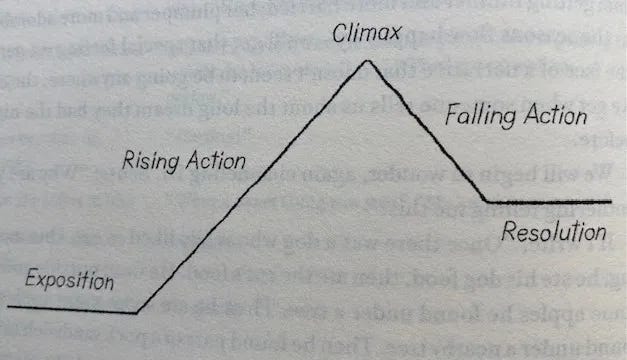
How finely can you divide a story before Freytag’s triangle stops applying? Consider a ball game. There’s a ball game. And within it there’s an inning., with the classic rising-action/resolutions of rallies and third outs. Within that is is the plate appearance, with rising action (count development) and resolution (PA result). And within that result is often a ball in play, which is a little story scene, too. For instance, in the eighth inning of the tied Mets/Phillies game on the 28th day of this season, Max Kepler had a two-out single to right field, Nick Castellanos tried to score, Juan Soto threw home, and Hayden Senger tagged Castellanos out on a close play at the plate.
Each nesting narrative has an arc. But on that play in particular, there’s one more layer to which we can descend. You’ve seen this scene several hundred times in the past few years:
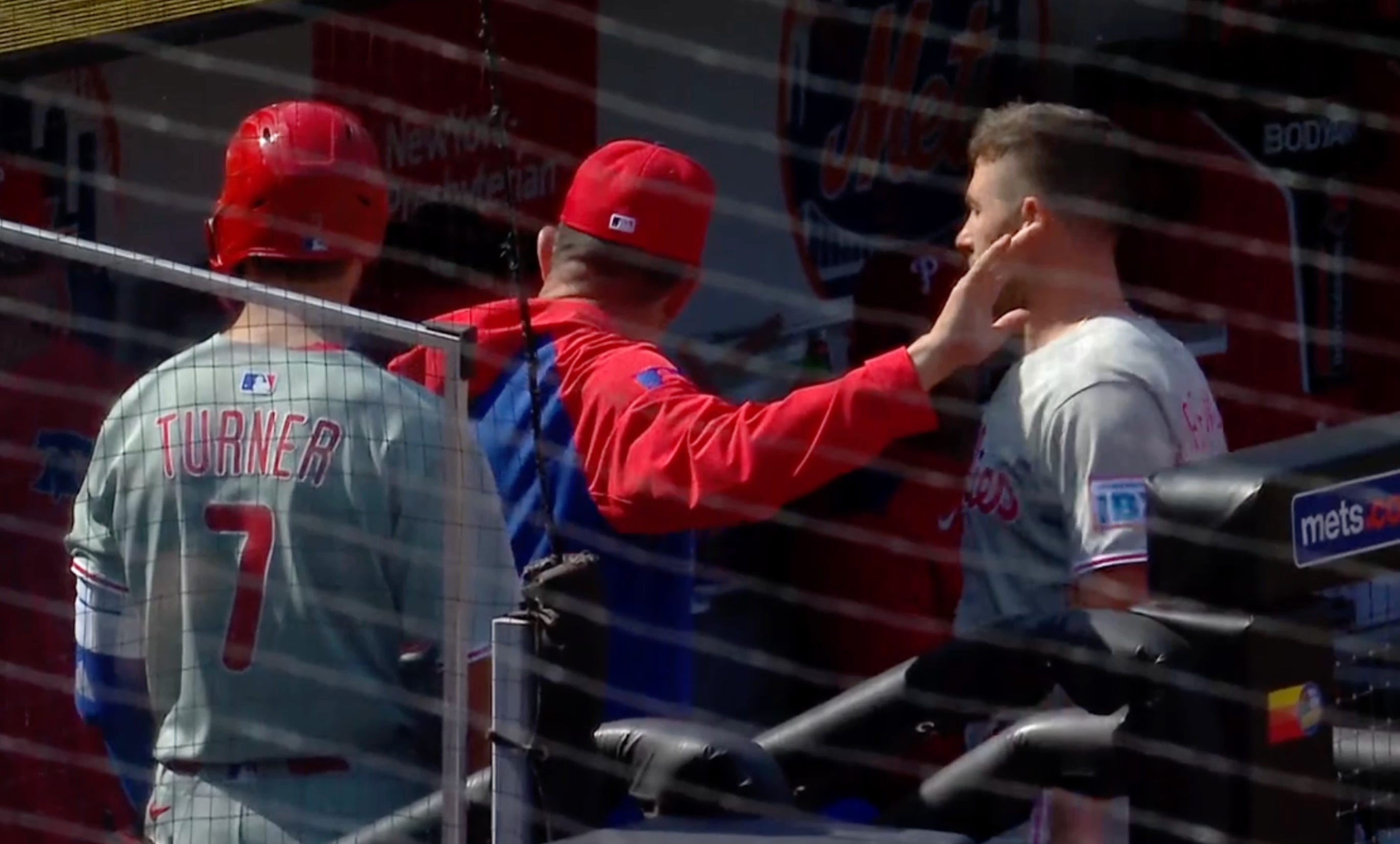
That’s a manager—in this case, the Phillies’ Rob Thomson—holding a hand up to pause the game while he decides whether to challenge the call at home plate. One of Thomson’s coaches is on a phone at the bottom of the dugout, talking to the club’s video guy in a different room under the stadium. We’re all waiting to find out whether the Phillies will challenge, and the tension is ramped up by a time limit. He has only 15 seconds to make his decision!
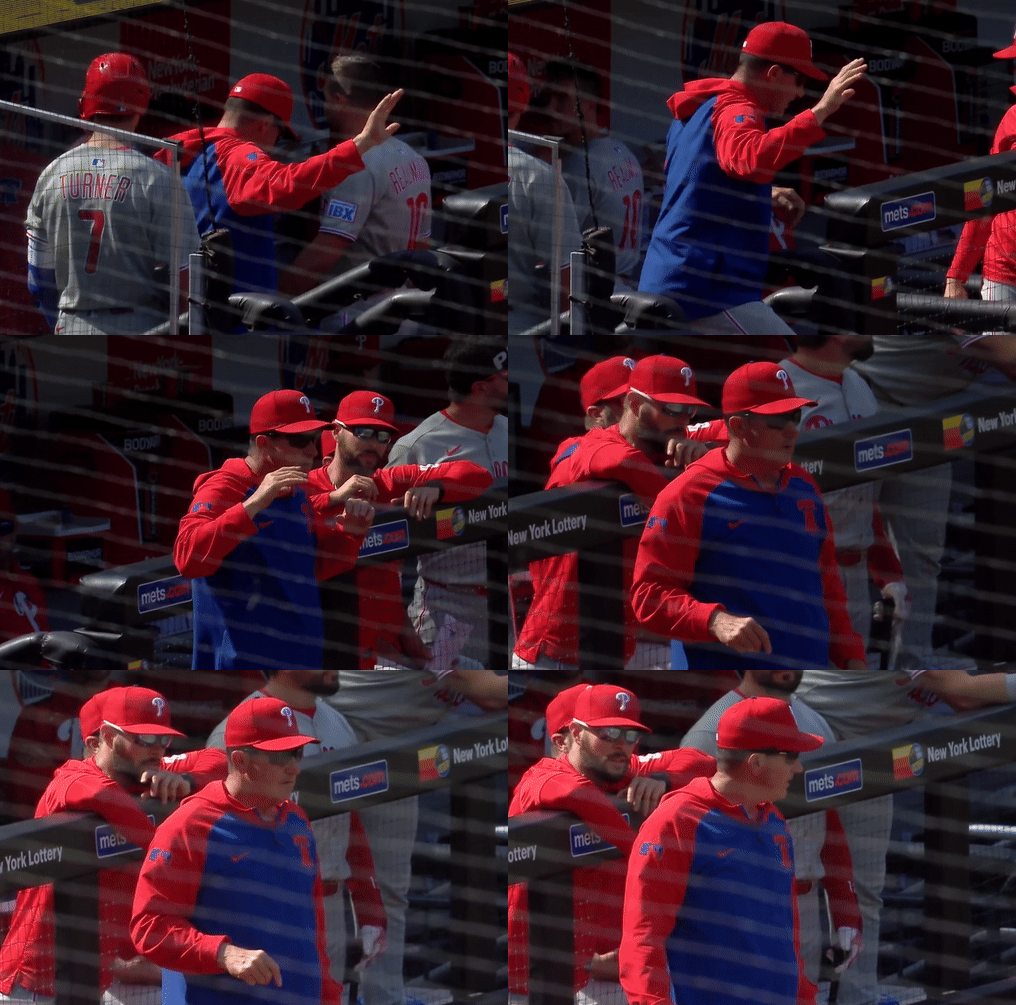
And every so often, the manager won’t do it in time. The deadline passes. He has failed the Replay Scene. That story looks like this:
***
This is a little bit of an explainer post for people who, like me, feel a little anxiety when we see that manager with his hand up. We know time is running out, but—since there is no visible clock—we don’t know how quickly.
So what is the nature of this clock? Do the managers know how much time they have left, or are they relying on an internal clock in their heads, and hoping that it aligns with the umpire’s internal clock, or… or what? There seems to be a lot of clock ambiguity.
The good news, for our anxiety, is that it’s not nearly as ambiguous on the field as it is for us at home. When a manager initially holds up a hand to signal he might review the call, the umpire acknowledges the manager, and uses a communication device to tell the Field Timing Coordinator to start a 15-second Determination Timer. The clock in the stadium begins counting down, in full view of everybody at the game.
The bad news, for your anxiety, is this isn’t a countdown you can see at home. The scoreboard bug, which counts down the pitch clock, doesn’t bother with this one. And the stadium countdowns are almost never visible at home, or are just barely visible in the background of celebration shots:
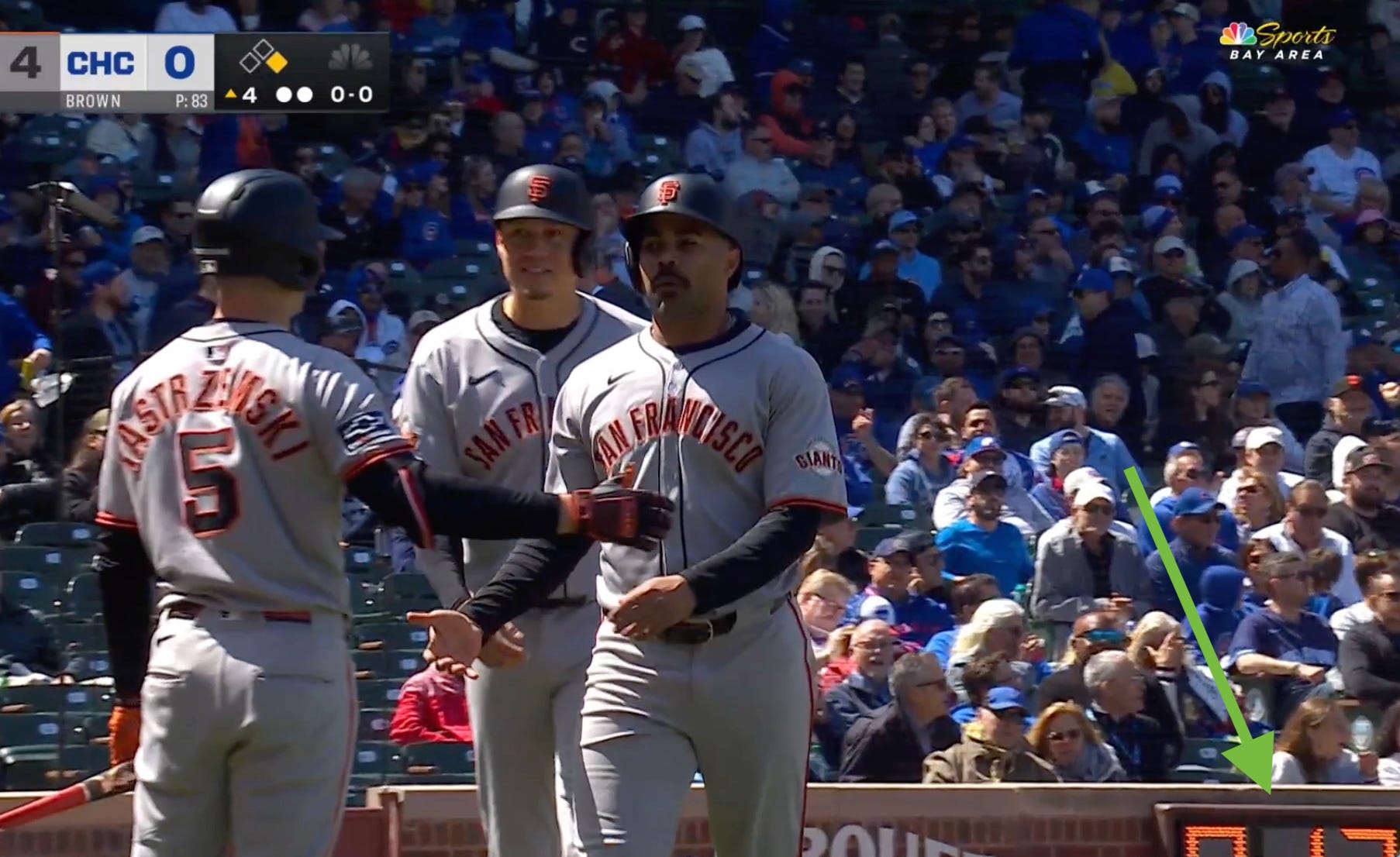
So while the manager should know how much time is left, you won’t.
The Mets’ broadcast, when discussing Thomson’s failure to challenge in time, noted that Thomson’s request came “20 seconds from the time of the out call. The rule is 15 and (umpire) Mark Wegner called him on it.” But the rule isn’t 15 seconds from the time of the out call, but from the time of the manager’s hold-for-time signal. And since the camera probably wasn’t showing the manager or the umpire when the initial hold-for-time signal was made, we at home can’t know when the 15 seconds began to disappear. We just have to guess, basically.
Presumably, the person in the video room also doesn’t see this clock, so for them this is probably pretty stressful. The coach on the phone in the dugout probably can’t see the clock. The manager can’t if he’s got his head turned away from the field, as Thomson does. But he can see if it he looks out to the field, and he should be tracking it. There’s no reason for him not to. It is a huge yellow clock that’s entirely for him.
Of course, for Thomson in that situation, missing his window is even sillier. It was the eighth inning. Challenges that late in the game are basically free. The win expectancy flip from an out call to a safe call would have been 37 percent. And the play was obviously close, no need to ask somebody with access to video to confirm that. This scene did not reflect well on Thomson at all.
**
Two tiny details that mean very little but interested me anyway:
The official guidance to umpires is that the clock starts once “a Manager provides an Umpire with a timely notification that the Club is considering a challenge.” There is no definition of timely, and there is no clock counting that down, so there is still a little bit of clock ambiguity. It just happens earlier in the scene.
When the pitch clock reaches zero, the umpire gets a haptic notification—a little vibration, so he knows the clock hit zero without having to look at it. But the 15-Second Determination Timer does not trigger this haptic notification. So the umpire does have to be looking at the clock to know that it expired, and is thus slightly more likely to miss it, and perhaps slightly more empowered to extend grace.
*
*
*
Circling back to —
Day 25 Of The 2025 MLB Season
Last June, a bat slipped from Vladimir Guerrero Jr.’s hands on a swing. It sailed over the Blue Jays’ dugout and got stuck in the netting that separates field from fans. It hung up there for a couple innings, until the Blue Jays’ team effort to bring it down—involving an extendable pole with a some tape fashioned into a loop at the end of it—finally succeeded.
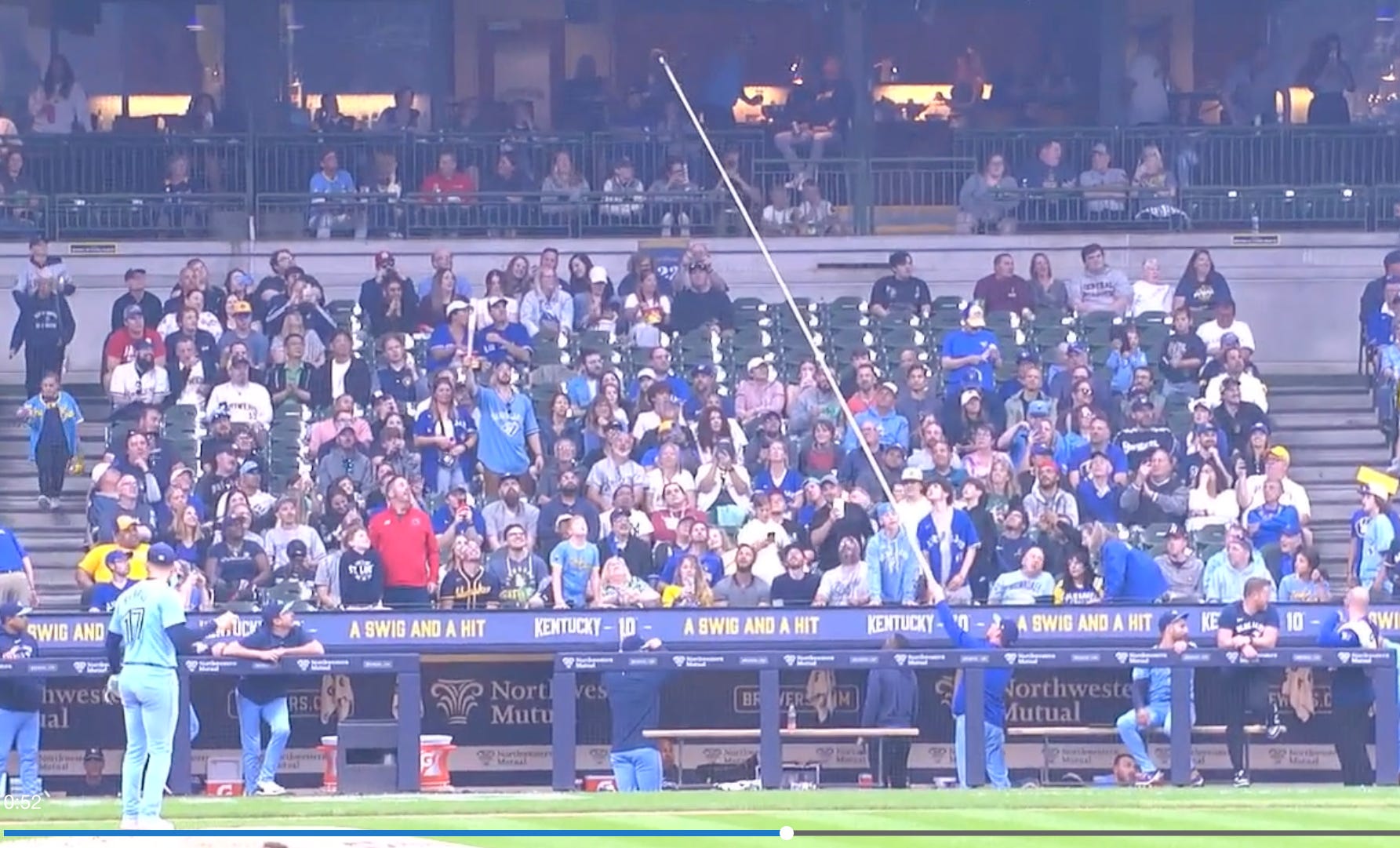
“You could do that a million more times and the same result would not happen,” one of the game’s broadcasters said, of the bat getting stuck in the net. I don’t know how he thinks he knows that.
**
There are three types of things:
