
Updates on Updates to Updates
Mid-season check-ups on the microtrends.

Programming note: I’m going to take next week to get my mind quiet, so don’t expect any emails from me. That will carry past the halfway point of the season, so I figured this was a good time to check back in on some of the micro-trends we’ve been tracking around here for the past few years.
All numbers are through Sunday’s games.
1. First-pitch-of-the-game swinging/First-pitch-of-the-game grooving
Batters are going to swing at the first pitch of the game. That’s not going to change now. They’re swinging more than twice as often as they used to, they’re hitting tons of dingers, they’re on pace to set a new first-pitch-of-the-game dingers record, they’re loving it:
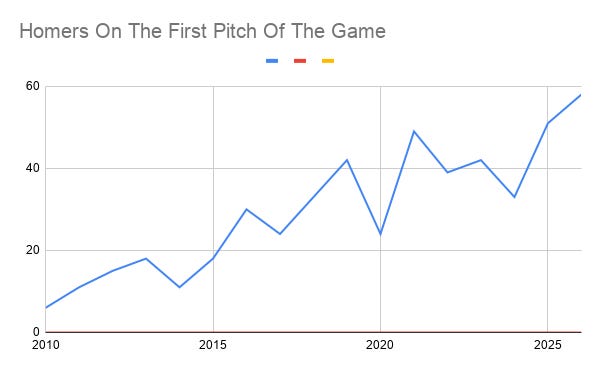
So for now we can count on the hitter’s side of this. The ongoing question is whether the pitchers will adjust, or whether we’ve found the one situation in all of sports where professional athletes simply don’t care about getting humiliated.
If pitchers were to adjust, we’d expect them to be less predictable (throw things other than fastballs) and less hittable (throw things other than pitches in the middle of the strike zone). Let’s see:
Fastball rate, first pitch of the game,
2010-2019: 92 percent
2020-2025: 93 percent
2026: 92 percent
Heart-of-zone rate, first pitch of the game,
2010-2019: 32 percent
2020-2025: 33 percent
2026: 30 percent
Still throwing all fastballs. Maybe a little more cautious with the fastball. I’ll be convinced when more than one half of 1 percent of games start with a changeup.
2. The end of no-hitters/the eventual elevation of complete games to no-hitteresque hero status
Last year was the first year since 2005 without a true, non-combined no-hitter in the majors. There hasn’t been one this year. If that holds, it would be the first two-season gap since the hinky WWII seasons. There’s obviously nothing impossible about no-hitters—Yoshinobu Yamamoto and Parker Messick both took bids into the ninth inning this year before allowing hits—but as more bids get interrupted by pitch count, there are just a lot fewer late-game attempts. So even though pitchers give up fewer hits than almost any time in history, the no-hitter is getting rarer.
There have been nine interrupted no-hitters this year—a starting pitcher going at least 70 pitches1 before being removed from an active no-hitter—which pro-rates to 20 over a full season. That would be a record. That would be as many as all of AL/NL history through the year 2003.
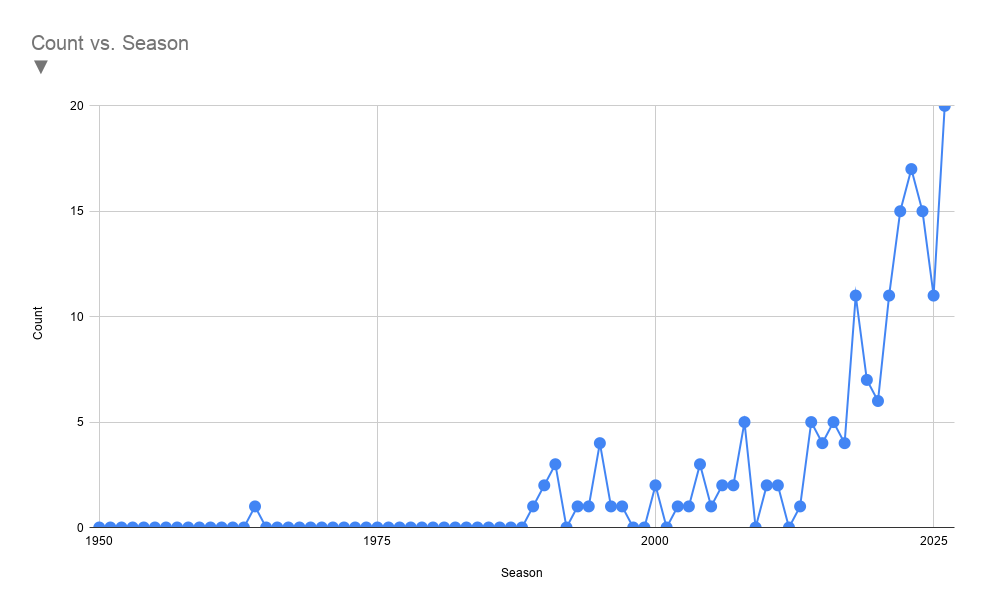
“The end of no-hitters” was the extent of my original proposal, but lately I’ve started to think we’re moving toward an era where simple complete games become the equivalent of no-hitters. Just as “140 pitches” got replaced by “120 pitches,” and then “120 pitches” got replaced by “100 pitches,” “100 pitches2” has now been replaced by “90 pitches.” Drew Rasmussen got pulled from a start the other day after 84 pitches; his line was 7/1/0/0/0/9. Logan Gilbert got pulled from a start after 87 pitches, with a 6/1/0/0/0/9 line. Kris Bubic: 7/2/0/0/1/11, 83 pitches. Max Meyer: 7/1/0/0/1/7, 83 pitches. There are dozens of starts like this. You can’t dominate more than those guys, and you can barely dominate more efficiently than those guys, but they’re still pulled after six or seven.
There are, meanwhile, only seven complete games this year, and six of them are shutouts. That last detail—I’m breathless. In Justin Verlander’s first season in the majors, there were 104 starters who were allowed to go nine innings in a non-shutout. In what might be Verlander’s final season, there has so far been one.
We used to have the shutout, an elevated subsection of complete games. But now complete games and shutouts are almost synonymous. We used to have the Maddux, an elevated subsection of complete games. But increasingly, complete games have to be Madduxes to have any shot. We used to have no-hitters, a rarefied subsection of complete games. But in 10, 20 years, there might not be a difference. To throw a complete game might well require perfection.
Creeping sign of this: The way pitchers celebrate the last outs of their complete games is edging toward the way they used to celebrate the last outs of no-hitters:
3. The Catcher’s Interference Frenzy
